
The table is where family stories get told.
This Thanksgiving, pass the stories along with the sweet potatoes.
Thanksgiving Day, November 26, is also National Family Health History Day. It’s one of the few days a year when several generations sit at the same table. That makes it the perfect time to ask the questions that could protect your health, and your children’s.
What did Grandma’s heart trouble turn out to be? How old was your uncle when he was diagnosed with diabetes? Did your aunts have fibroids? Those answers are more than family lore. To your doctor, they are clues.
Free download: IAWH’s Around the Table Family Health History Kit has conversation starters, a fill-in Family Health Chart and a page to take to your doctor. Download the kit.
Why it matters
Families share genes, and they also share kitchens, habits and neighborhoods. Together, those shape your risk for many common conditions. A few numbers show how much is at stake:
- Breast and ovarian cancer. About 13% of women in the general population will develop breast cancer in their lifetime. Everyone has two genes called BRCA1 and BRCA2. Normally, they help repair damaged cells and keep cancer from growing. A harmful change (mutation) in one of them, passed down from a mother or a father, keeps the gene from doing that job well. For women who inherit one of these changes, breast cancer risk is more than 60%. Lifetime ovarian cancer risk rises from about 1% to as high as 39–58% with a BRCA1 change.
- Inherited high cholesterol. About 1 in 311 people have familial hypercholesterolemia (FH), an inherited condition that causes very high cholesterol from birth. Without treatment, about 30% of women with FH have a heart attack by age 60.
- Early heart disease. Your risk of coronary artery disease is higher if a close relative developed it early: a father or brother before age 55, or a mother or sister before age 65.
- Type 2 diabetes. Having a parent, brother or sister with type 2 diabetes is a known risk factor. And more than 2 in 5 American adults already have prediabetes.
- Colorectal cancer. About 1 in 4 people with colorectal cancer have a family history of the disease.
How knowing changes your care
Family history is useful because it changes what you and your provider do next. Some real examples:
- Earlier colorectal screening. Most adults begin colorectal cancer screening at 45. If a parent, brother, sister or child had colorectal cancer, guidance from the Colorectal Cancer Alliance is to start at 40, or 10 years before the youngest family member’s diagnosis, whichever comes first.
- Tailored breast screening. Women with an inherited BRCA change often start breast screening younger, sometimes with an MRI in addition to a mammogram. They can also discuss steps that lower risk, including medications and preventive surgery.
- Catching inherited high cholesterol. A family history of early heart attacks can prompt a cholesterol test and, if needed, genetic testing for FH. Finding and treating FH early can lower the risk of coronary artery disease by about 80%. Once one person is diagnosed, relatives can be tested for the same gene change.
- Getting ahead of diabetes. If diabetes runs in your family, ask about a blood sugar test. If you have prediabetes, the CDC-led National Diabetes Prevention Program lowers the risk of developing type 2 diabetes by 58%, or 71% for people over 60.
In each case, the family story leads to a test, and the test leads to action, often years before symptoms would.
Your history is not your destiny
Here is the most important thing to know: a family history of a disease does not mean you will get it. As Washington State’s Department of Health puts it, “a higher risk doesn’t mean you will definitely develop it.” The reverse is also true. No family history doesn’t mean you’re entirely in the clear.
Knowing your family’s story simply tells you where to focus first.
Genes aren’t the whole story. What you eat, how you move, whether you smoke, how you manage stress and whether you get screened all shape what happens next. Many of the conditions that run in families, like heart disease, high blood pressure and type 2 diabetes, are the same ones that respond to prevention.
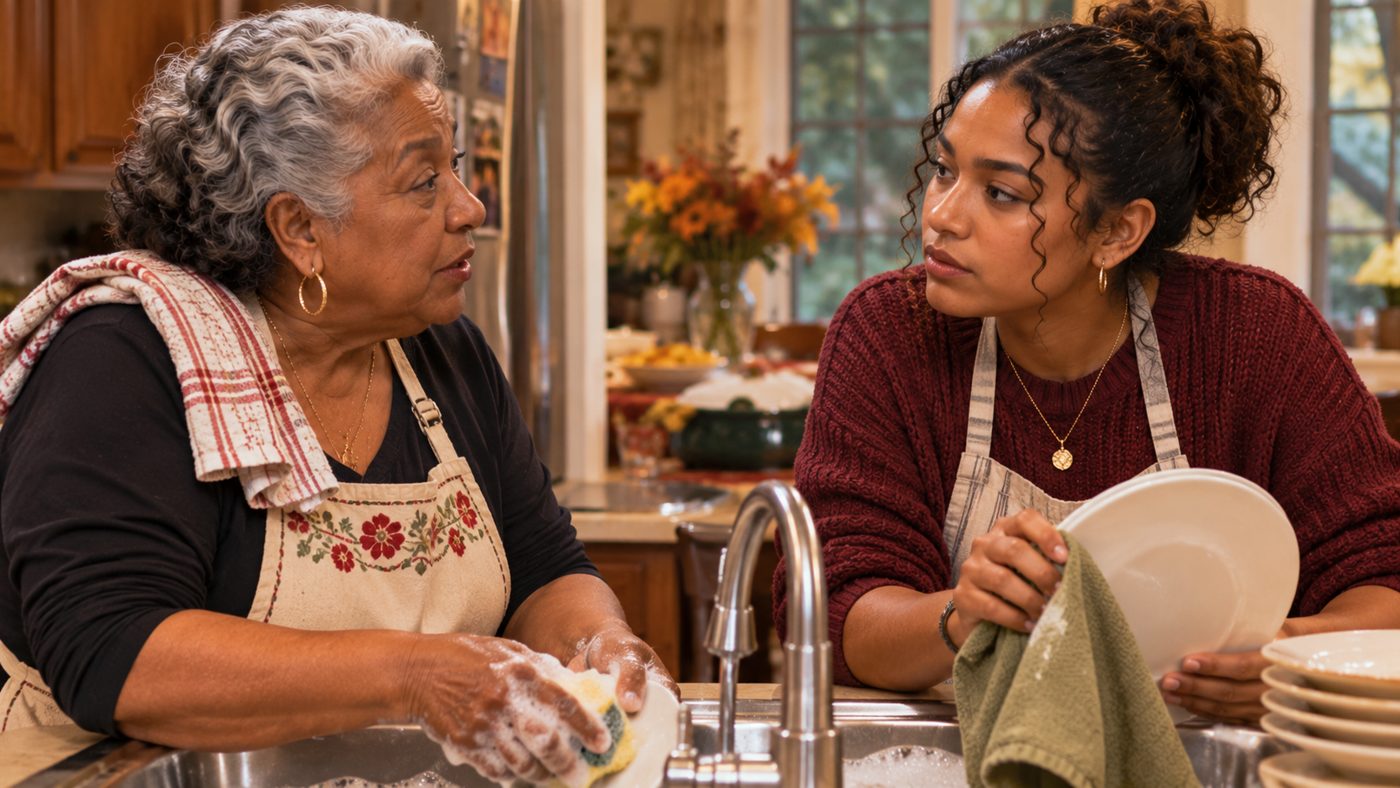
Some of the best conversations happen at the sink.
How to start the conversation
You don’t need a formal sit-down. Try these approaches:
- Around the table. Raise it while everyone is gathered: “I’m putting together our family health history. Can I ask a few questions?” Elders often enjoy being the keepers of the family story.
- One on one. Some health stories are private or painful, and some relatives won’t share in front of a crowd. A quiet moment while washing dishes, on a walk or over a phone call may get you further.
- Let people pass. “I don’t know” is an answer, too. Write it down and keep going.
- Write it down and share it. Fill in what you learn, bring it to your next checkup and give a copy to your siblings and grown children. It’s their history, too.
Make it fun, not an interrogation
- Start with stories, not symptoms. Ask where Grandma grew up, what her mother cooked or what she remembers about her own grandparents. Health details tend to come up on their own.
- Pull out the photo album. Old pictures spark memories. “Who’s this? Whatever happened to him?” opens the door gently.
- Make someone the family historian. Put a teen or grandchild in charge of the chart. Elders often open up to younger relatives, and the kids learn their family’s story.
- Share first. Lead with your own news: “My doctor asked about our family’s heart health, and I realized I didn’t know.” People relax when you go first.
- Keep it short. A question or two between the turkey and the pie is plenty. You can pick it up again at Christmas.
Download the free IAWH “Around the Table” Family Health History Kit. It includes conversation starters, a fill-in Family Health Chart, a page to capture family stories and a page to take to your doctor. Download the kit here.
Sources
National Cancer Institute: BRCA Gene Changes: Cancer Risk and Genetic Testing
CDC: About Familial Hypercholesterolemia
Kaiser Permanente Health Encyclopedia: Coronary Artery Disease: Family History
CDC: Prediabetes: Your Chance to Prevent Type 2 Diabetes
Colorectal Cancer Alliance: Family History and Colorectal Cancer
Washington State Department of Health: Family Health History
This article is for general education and is not medical advice. Talk with your health care provider about your family health history and your own health.
Free · Monthly · Evidence-Based
Get the IAWH Health Journal
Health news and practical guidance for women, delivered to your inbox once a month. Subscribe and never miss an issue.
Subscribe to the JournalAlready a subscriber? Share this page with a woman you love.